
HOL and Connection, Capacity and Meaning
Capacity
The nature of schooling has arguably become increasingly dominated by abstracted curriculum of limited immediate relevance to students. As a result many young people find themselves disadvantaged or less connected to the core business of the classroom, especially those whose temperament is not well disposed to sitting for long periods of time, or those who do not naturally absorb or process information delivered in a predominantly visual manner. Compounding this effect is the sequential nature of curriculum —especially in Mathematics and English—such that a student who disengages at some point can easily become locked into an experience of feeling left behind and lacking the ability to catch up, contributing to a sense of being out of control – a passive spectator in the classroom.
In HOL the emphasis is not on a set curriculum but rather on practical tasks that have an inherent purpose. For instance, constructing a beach volleyball court that students use during lunch provides direct relevance to the HOL students' lives (see Figure 3). In this instance students are creating a product of utility that the whole school community will benefit from. Furthermore, the skills they develop to build it have an application beyond the immediate project.
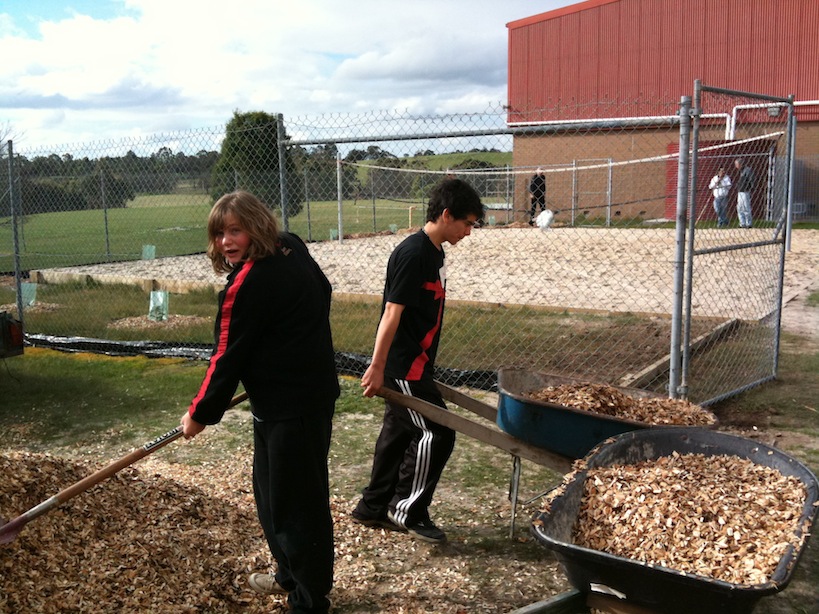
Figure 3: HOL students putting the finishing touches on a beach volleyball court they built at their school in country Victoria.
Collaborating on real projects helps to give students a sense of achievement in a way that is qualitatively different from completing a set of textbook exercises. The idea that students view HOL as somewhere that they engage in real work – unlike what they perceive themselves to be involved with in the classroom, is a recurring theme in their feedback.
“Helping out around school feels like real work instead of writing in a book. Last year we helped build a huge deck around an old maple tree outside the principal’s office. Each time I go past I think this is brilliant. If I can do that, imagine what else I can do, you get a real confidence boost.”
Max, Year 10, St Francis Xavier College, Berwick
“I hate doing school work, but this is something I can actually do because I’m a hands on person. We use maths every day with the measurements, but it’s real, not like class. Most people can relax when they’re doing Hands On instead of stressing you’ll get bad grades, but when we do Hands On if you make a mistake you can work on it next time.
Dylan, Year 9, Northern Bay Secondary College
Data from independent studies/evaluations reveal that amongst the benefits students derive from HOL are: enhanced confidence; a sense of genuine success; and the development of practical skills (Delloite Access Economics, 2012; KPMG, 2009; Burke, 2007). Many are able to start connecting the curriculum they encounter in class to the real world and thereby start to appreciate what they had previously rejected as irrelevant (Lamb & Rice, 2008). Disruptive students who need to strengthen their pro-social skills are unable to use the irrelevance of the work they are engaged in as an excuse for their misbehaviour. This creates an opportunity for the HOL artisan-teachers to help such young people become aware of the underlying weakness in their social skills and to work on strategies that will strengthen them (Hands On Learning, 2013). Feedback from these young people reveals that can be oblivious to the impact their behaviour has on others, and consequently, themselves. Developing insight and better social skills can free students from counterproductive and limiting behaviours giving them greater self-awareness, more self discipline, and a greater sense of control over their lives.
The benefits that accrue from engaging in undeniably real work also helps to diminish the sense of disconnection and irrelevance that otherwise dominates these young people’s experience of school, helping to introduce or strengthen the sense of purpose and meaning in their lives, as explored further below.